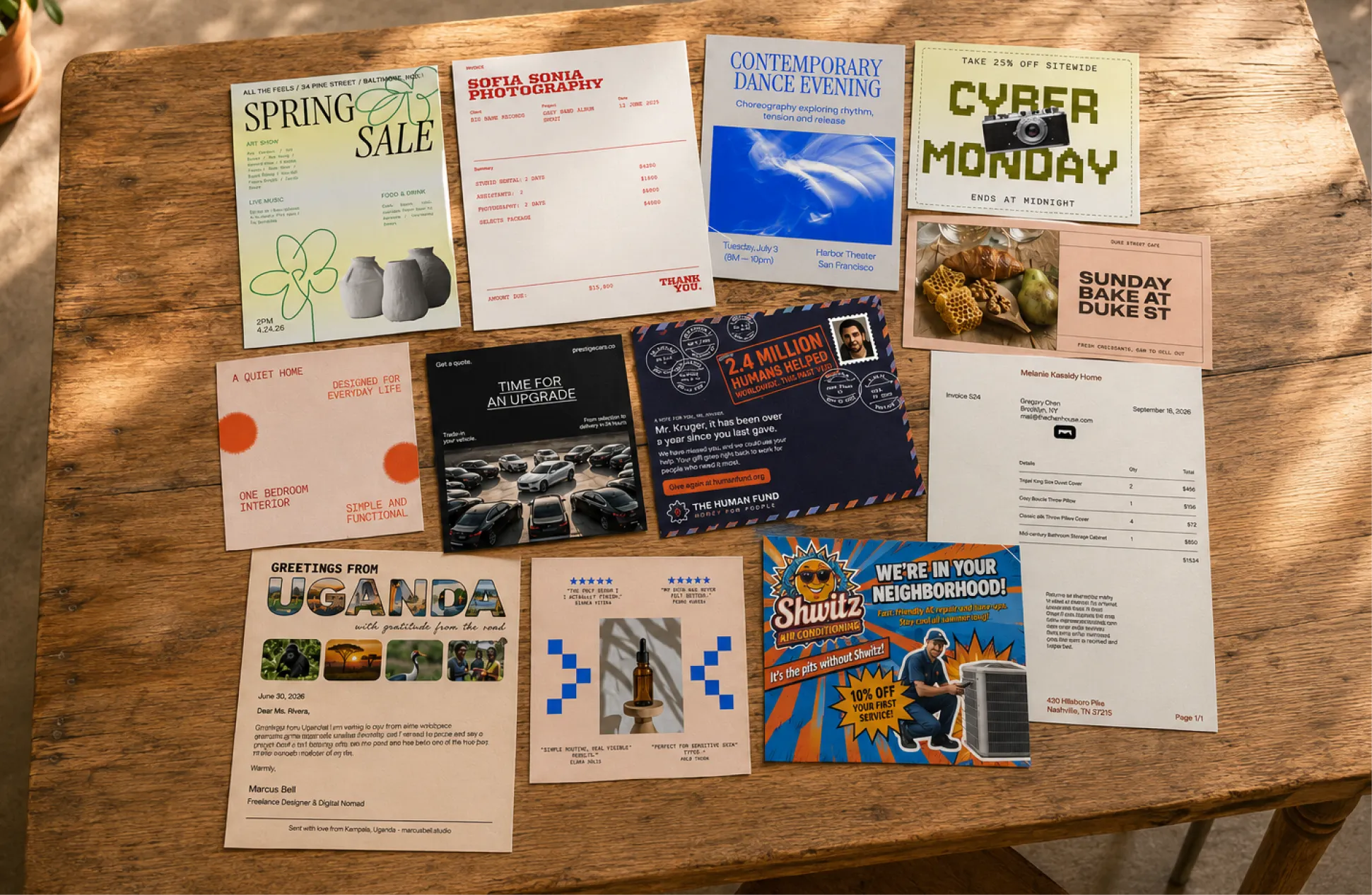
Postcards have outlasted fax machines, print classifieds, and banner-ad hype. In 2026, they remain one of the most cost-effective ways to land a message directly in someone's hands. This complete guide covers everything from postcard history and design to targeting, automation, and the economics of putting physical mail into a modern marketing strategy. Along the way, you'll see how MailerBot makes the entire process fast, personalized, and scalable for any business or solo creator.
- Postcards are a high-ROI, low-friction direct mail format that still delivers in 2026, especially when paired with digital marketing and trackable QR codes.
- MailerBot lets any business, nonprofit, or solo creator send personalized postcards and letters on demand-from a laptop or programmatically via API, Zapier, or Make.com.
- Dynamic merge fields, variable images, and unique QR codes turn every postcard into a measurable, trackable piece of your marketing strategy.
- This article is a complete guide covering postcard basics, design, targeting, testing, economics, and how to integrate postcards into broader marketing funnels to make more money.
What Is a Postcard in 2026? (And Why Marketers Still Love Them)
A postcard is a rectangular piece of thick paper or thin cardboard intended for mailing without an envelope. Common sizes run from 4"×6" to 6"×9" or larger. Postcards combine physical presence, visual design, and a short message into a single piece of mail that's seen the moment it's pulled from the mailbox. That instant visibility-no envelope to open, no spam filter to dodge-is why marketers keep coming back to them.
The modern postcard originated in Austria-Hungary on October 1, 1869. Postcards were introduced to Britain in 1870 and the United States in 1873. The introduction of real photo postcards by Kodak in 1903 fueled a worldwide craze, and during the "Golden Age" of postcards, roughly 1890 to 1915, their popularity exploded. Following the 1893 Chicago World Fair, souvenir postcards became immensely popular and helped promote tourist destinations long before digital photography. The usage of postcards in Britain grew from 75 million in 1871 to over 800 million annually by 1910. Postcards provided an inexpensive communication tool before telephones became widespread.
Today, postcards remain popular as travel souvenirs, personal greetings, and collectibles. Postcard collecting, known as deltiology, is a popular hobby, and many postcards are prized by collectors for both cultural and monetary value. Postcards preserve snapshots of cities, landmarks, and daily life, providing historical insights across decades. But what matters most for this guide is their role as conversion tools. Postcards can serve as keepsakes, art pieces, and marketing tools-and MailerBot, an on-demand print company from the brains behind Handwrytten, is built to help businesses, nonprofits, and digital nomads send beautiful, personalized postcards and letters from anywhere.
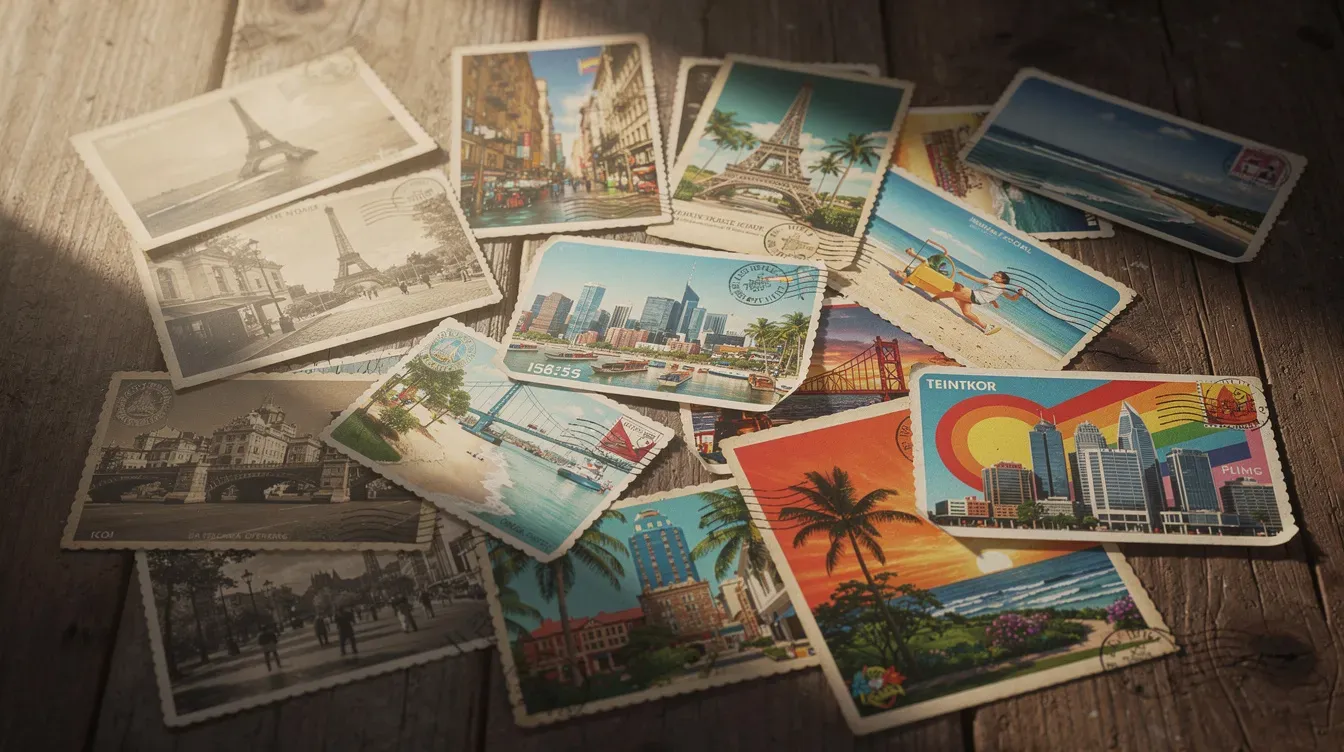
Postcards have outlasted fax machines, print classifieds, and banner-ad hype.
How Businesses Use Postcards Today: Real-World Examples
- Home services: A Phoenix HVAC company sends 5,000 spring tune-up reminder postcards each March to homes within a 5-mile radius, including a promo code and QR code for a free diagnostic.
- Nonprofits: A 501(c)(3) animal rescue mails year-end donation reminder postcards every November with impactful animal photography and a QR code linking to a GivingTuesday donation page.
- Retailers: An independent clothing boutique in Austin promotes a July 4th weekend sale with a 20% off in-store coupon code printed on each card-and follows up with email retargeting for recipients who scan the QR code.
- SaaS and B2B: A software company mails personalized conference follow-up postcards to 300 high-value prospects, each with a unique demo URL and a QR code to schedule a call.
- Digital nomads and creators: A travel YouTuber sends patrons monthly photo postcards from different countries via MailerBot, without ever visiting a post office.
- Healthcare: Dentists and optometrists send friendly check-up reminders two weeks before an appointment is due, with a link to online booking.
All of these can be automated through MailerBot's API, MCP server, or tools like Zapier and Make.com.
Postcards vs Digital Marketing: Better Together, Not Either–Or
Postcards and digital channels aren't competitors-they're partners. Here's how they compare and complement each other:
- Visibility: Nearly every physical postcard is at least glanced at. Direct mail engagement hovers around 79–90%, while email open rates often land between 20–30%.
- Warming cold audiences: Send postcards to specific ZIP codes, then run Google or Meta ads in the same geography. Recipients who already saw your card are more likely to engage with your online ads.
- Example funnel: Postcard with QR code → mobile-optimized landing page → email capture → retargeting ads → follow-up postcard for cart abandoners.
- Tracking: Unique URLs, coupon codes, and UTM-tagged QR codes make postcards part of measurable inbound marketing, not just offline branding.
- MailerBot integration: MailerBot supports dynamic QR codes and merge fields at scale, so each postcard can lead to a unique, personalized digital experience.
The point is simple: postcards give you access to attention that digital channels alone can't reach.
Understanding the Economics: How Postcards Help You Make More Money
Let's run the numbers. Suppose you mail 2,000 postcards at $.49 each (print + postage + processing). That's $980 total. At a 3% response rate, you get 60 orders. If average order value is $80, revenue is $4,800. Your gross profit: $3,820, a 390% ROI. Even at a conservative 1% response, revenue is $1,600-still above break-even for most offers.
Compare that to paid social or search: CPCs on Meta and Google have risen year over year, and ad fatigue keeps pushing cost per acquisition higher. According to DirectMail.io, the blended cost per piece for a well-targeted postcard sits between $0.35 and $0.65-competitive with many digital channels and often yielding a lower customer acquisition cost.
Lifetime value matters here, too. A customer acquired via postcard who returns for repeat purchases or renewals drops your effective acquisition cost dramatically. For nonprofits, a single donation postcard can spark a relationship worth years of annual giving.
Automating printing and mailing through MailerBot eliminates in-house printing, envelope stuffing, and post office runs, which saves labor cost and lets even a one-person company scale direct mail like a corporate team.
From the brains behind Handwrytten comes MailerBot-an on-demand print company that lets everyone from home services companies to nonprofits, retailers, and digital nomads send beautiful postcards and letters from a laptop.
Core Types of Postcards for Marketing Campaigns
Not all postcard campaigns serve the same goal. Here are the main types, each mapped to a specific stage in the buyer journey:
- New customer acquisition: Neighborhood saturation mailers, grand opening announcements, introductory offers with expiration dates targeting prospective customers.
- Retention and brand loyalty postcards: Birthday offers, anniversary "thank you" notes, VIP sale invitations tied to a customer's first purchase date.
- Event marketing and appointment reminders: Dental check-up reminders sent two weeks before due date, webinar reminders for B2B prospects, trade shows follow-ups.
- Reactivation and win-back: For lapsed buyers (no purchases in 9+ months) with a "we miss you" discount and QR code to a tailored landing page.
- Fundraising and awareness: Nonprofits, local elections, or community campaigns combining storytelling photos and short URLs to drive donations or customer interest.
- Transactional and follow-up: "Thank you for your order" with a review request link or referral code, triggered automatically from a CRM via the MailerBot API.
Market Research for Postcard Campaigns
Effective market research shapes every element of a postcard campaign:
- Internal data: Analyze purchase frequency, average order value, last order date, and ZIP clustering to identify your best segments. Needs-based segmentation is one of the most effective market strategies for deciding who receives which message.
- External data: Census data, USPS Every Door Direct Mail (EDDM) route demographics, and third-party list providers with interest, age, and income filters help you reach new buyers.
- Messaging decisions: Research tells you whether to lead with value or luxury, whether imagery should feature families or young professionals, and whether a flat discount or bundle performs better for your consumers.
- MailerBot compatibility: MailerBot works with both your in-house lists and third-party lists, as long as privacy and data regulations are respected.
Market segmentation helps target distinct consumer groups effectively-and postcards give you a tangible distribution channel to reach each one.
Designing Effective Postcards: Layout, Copy, and Visuals
Design can make or break a postcard campaign. Follow these best practices:
- One primary goal, one clear CTA: Call, visit a URL, scan a QR code, or book an appointment. Place it prominently.
- Visual hierarchy: Headline at top, hero image, short supporting copy, offer, CTA, and legally required elements (return address, postal indicia).
- Print specs: Use CMYK color mode, at least 300 DPI resolution, and include bleed (0.125" minimum). Consider 14pt or 16pt card stock-thicker stock signals quality and increases perceived value.
- Real photos over stock: Use real photos of your products, staff, or local scenes. Community-focused businesses and nonprofits especially benefit from authentic imagery. Picture postcards helped promote destinations for decades, and the same principle applies to promoting your business.
- Test formats: Compare 4"×6" vs 6"×9" postcards. Oversized formats trend toward higher response rates, though postage cost increases. Postcards are generally cheaper to mail than letters, making even oversized formats cost-effective.
MailerBot supports full-color, edge-to-edge designs and handles the art of print production so you don't have to.
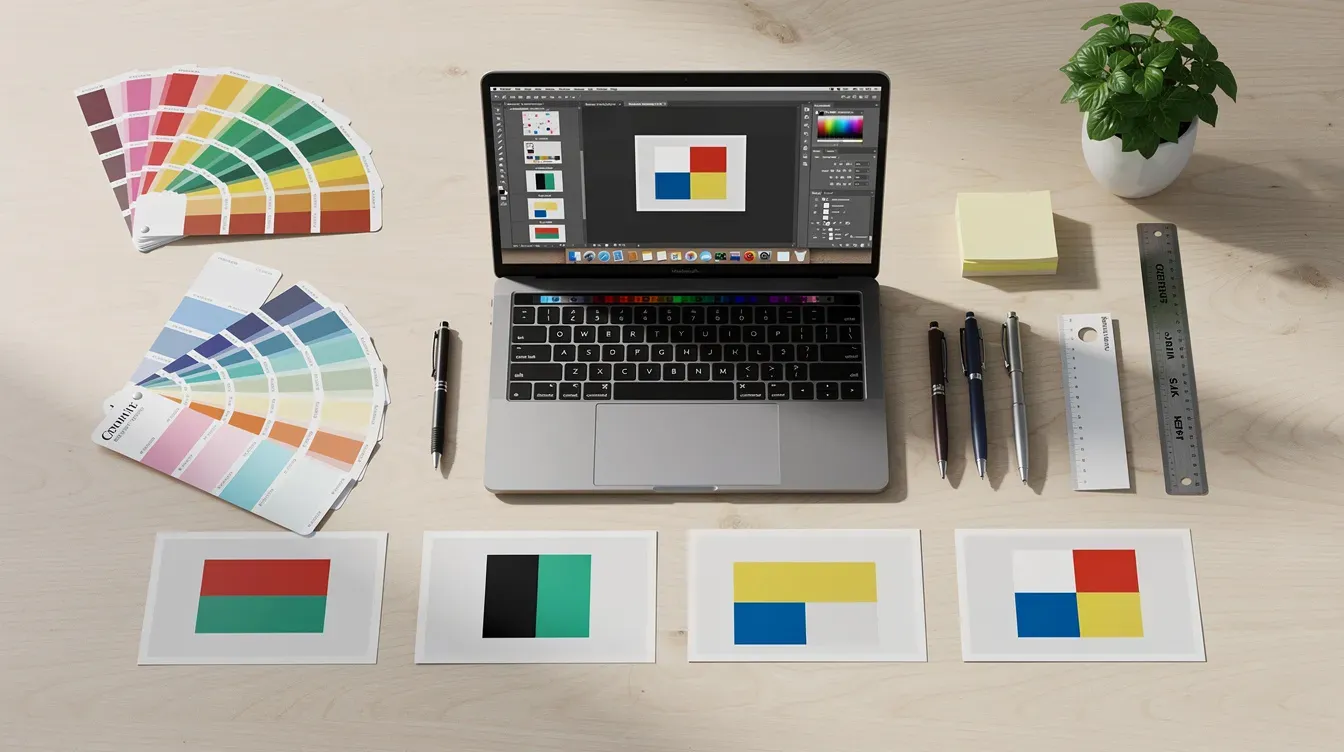
Personalization 2.0: Merge Fields, Variable Data, and QR Codes
Personalization is the single biggest lever for postcard performance. Personalized mail pieces see response lifts of up to 135% compared to static generics.
- Merge fields: Insert first name, last purchase date, nearest store location, or customized discount codes directly into the postcard copy. Each recipient gets a card that feels written for them.
- Variable images: Show different product photos based on customer category-pet owners see pets, parents see kid-focused imagery.
- QR codes: Each postcard can include a unique QR code linked to a personalized URL with UTM parameters for tracking in Google Analytics or similar tools.
- MailerBot at scale: MailerBot's API and automation tooling allow fully personalized postcards and letters triggered by events in your CRM or e-commerce platform. Letters via MailerBot can also include personalized headers, footers, and body copy using similar merge fields.
This is how you turn a static piece of cardboard into a measurable, high-converting touchpoint.
Targeting: B2C, B2B, and Nonprofits with Postcards
Different audiences require different targeting approaches:
- B2C: Focus on household-level targeting, life events (moving, new baby, home purchase), and interests inferred from purchase history. These are your end consumers, and postcards meet them where they live.
- B2B: Target decision-makers by job title and industry. Use office addresses. Send highly personalized postcards after conferences or webinars to other businesses you want as clients or partners.
- Nonprofits: Segment lists into current donors, lapsed donors, volunteers, and prospects. Tailor messaging and asks using each segment's giving history to maintain engagement and grow donations.
MailerBot supports uploading segmented CSVs or pulling segments dynamically via API, enabling different templates per audience segment.
Marketing teams can templatize postcard designs and workflows so future campaigns take hours, not weeks.
Postcards as Part of Complete Marketing Strategies
Marketing is defined as creating and delivering value offerings. The 4Ps of marketing-product, price, place, and promotion-still serve as a framework for how a company promotes its offerings. Postcards map directly to the fourth p: promotion.
Effective marketing strategies can yield significant business growth when postcards are woven into multi-touch campaigns:
- Multi-channel sequences: Emails + SMS + postcards over a 30–60 day window to the same leads. Postcards act as a physical anchor in a sea of digital noise.
- Reviving dead channels: Send a physical reminder to people who stopped opening your emails. It's a competitive advantage over competitors who rely exclusively on online methods.
- Behavior-triggered sends: Abandoned carts, trial expirations, or quote requests can trigger an automated postcard via MailerBot. Treat postcards as another high-intent touchpoint, the same way you plan social ads, public relations outreach, or email nurtures.
When a company integrates direct mail into its broader strategy alongside setting prices, developing new products, selling products through physical stores and digital channels, and investing in advertising-it builds a distribution system that's harder for competitors to replicate.
Tracking, Testing, and Optimizing Postcard Campaigns
If you can't measure it, you can't improve it. Here's how to track postcard performance:
- Tracking methods: Unique discount codes, dedicated phone numbers, personalized URLs, and QR codes printed on each card or segment.
- A/B testing: Split your list and test headline, imagery, offer, or size. Compare response rates and revenue per variant.
- Key metrics: Response rate, conversion rate, average order value, cost per acquisition, and ROI at both campaign and segment levels.
- Feeding data back: MailerBot's automation and data-friendly features (API, merge fields, QR codes) make it straightforward to pipe performance data back into your CRM for analysis. This is how you turn a single campaign into a repeatable investment in growth.
Workflow and Automation: How MailerBot Makes Postcards On-Demand
From the brains behind Handwrytten comes MailerBot-an on-demand print company that lets everyone from home services companies to nonprofits, retailers, and digital nomads send beautiful postcards and letters from a laptop. Print on Demand eliminates inventory management responsibilities: postcards and letters are created after a campaign is launched, not stockpiled in a warehouse. No upfront investment is required to start, and MailerBot handles fulfillment with local production and shipping.
Here's the basic workflow:
- Sign up and choose a postcard or letter template.
- Upload artwork or use a provided layout.
- Connect your data source: CSV upload or integration via Zapier/Make.com.
- Set merge fields and QR codes for personalization.
- Preview each piece, then launch.
MailerBot can be triggered programmatically through its API, MCP server, Zapier, or Make.com to send postcards based on real-time events. Letters can be created through the same system with fully personalized bodies, headers, and footers for higher-touch communications. Print on Demand allows global selling with local fulfillment, and with over 1,300 products available across the broader print-on-demand industry, postcards sit at the sweet spot of simplicity and impact.
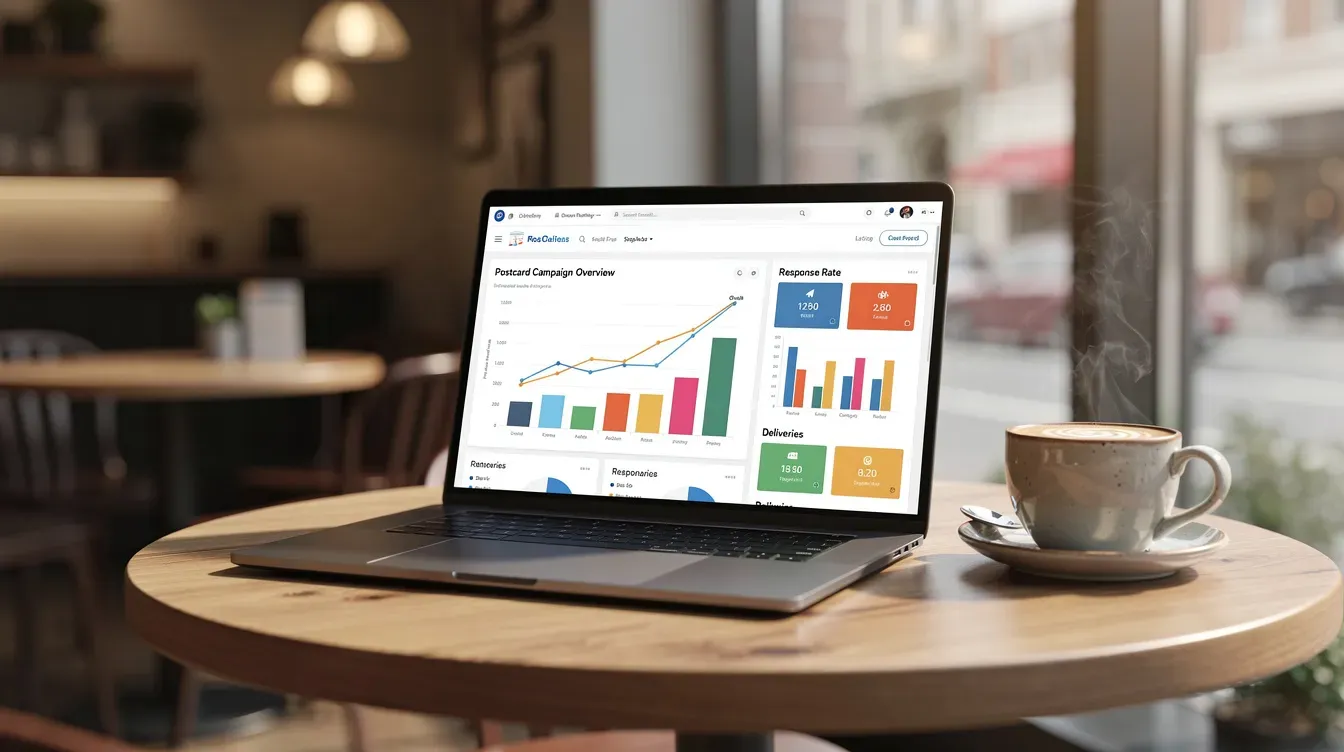
You don't need to be a developer to automate direct mail-but if you have one, even better:
- API use case: When a new customer spends over $200, your system calls the MailerBot API to send a personalized "VIP welcome" postcard within 24 hours. No manual work needed.
- Zapier scenario: Trigger a postcard when a contact moves to a specific stage in HubSpot, Pipedrive, or Zoho CRM (e.g., "demo completed"). The Zap pulls the contact's name, address, and deal value, then formats and sends the card.
- Make.com workflow: Daily batch export from your e-commerce platform → clean data → send to MailerBot for postcards to all clients who haven't purchased in 90 days. Management effort: near zero once it's set up.
These automations let organizations of any size act like they have an in-house direct mail department without touching a printer or post office. This is how sellers and buyers stay connected through a channel that cuts through digital clutter.
Creative Postcard Ideas for Different Industries
Here's a brainstorm list to spark your next campaign:
- Home services: Seasonal HVAC tune-up reminders, gutter cleaning before fall, roof inspection offers after major storms in a specific county.
- Retail and eCommerce: Product launch postcards with a QR link to a lookbook, "back to school" coupons, loyalty tier upgrades with personalized discount amounts. Great for exchanging offerings for brand loyalty.
- Hospitality and travel: Hotel "we miss you" offers six months after checkout, tour companies sending sample postcards of destinations for early-bird booking campaigns.
- Healthcare and education: Dentists and vets sending check-up reminders, vaccination notices, or semester-start welcome postcards to students and supporters.
- Nonprofits: Campaign progress updates with infographics printed on the card, holiday giving appeals, volunteer appreciation cards that serve the community.
- Professional services: Year-end tax planning reminders from accountants, estate planning awareness cards from law firms, annual portfolio review invitations from financial advisors. These build trust and brand identity with each send.
Trust matters. When you handle mailing addresses and personalized data, follow these rules:
- Consent and opt-out: Honor do-not-mail lists. Respect regional regulations-state-level privacy laws in the US, and GDPR if mailing to the EU.
- Secure data handling: Use reputable platforms like MailerBot with robust access controls for storing and transmitting mailing lists. White papers and privacy policies should be available for review.
- Sensitive information: While postcards aren't subject to email-specific laws like CAN-SPAM, never print sensitive data (health, financial details) openly on a card. Anyone in the delivery chain can read it.
- MailerBot's role: MailerBot focuses on secure handling of customer data for printing and fulfillment, giving you peace of mind across every campaign.
Postcards vs Other Direct Mail Formats: Letters, Brochures, and More
Postcards are the fastest, simplest, and often cheapest format for sales promotions and quick offers. Letters shine when you need longer narratives or reply devices-think fundraising appeals or corporate proposals. Brochures or mini-catalogs work for wide assortments and product improvement showcases.
MailerBot supports both postcards and letters, so marketers can choose the right format for each step-without switching platforms.
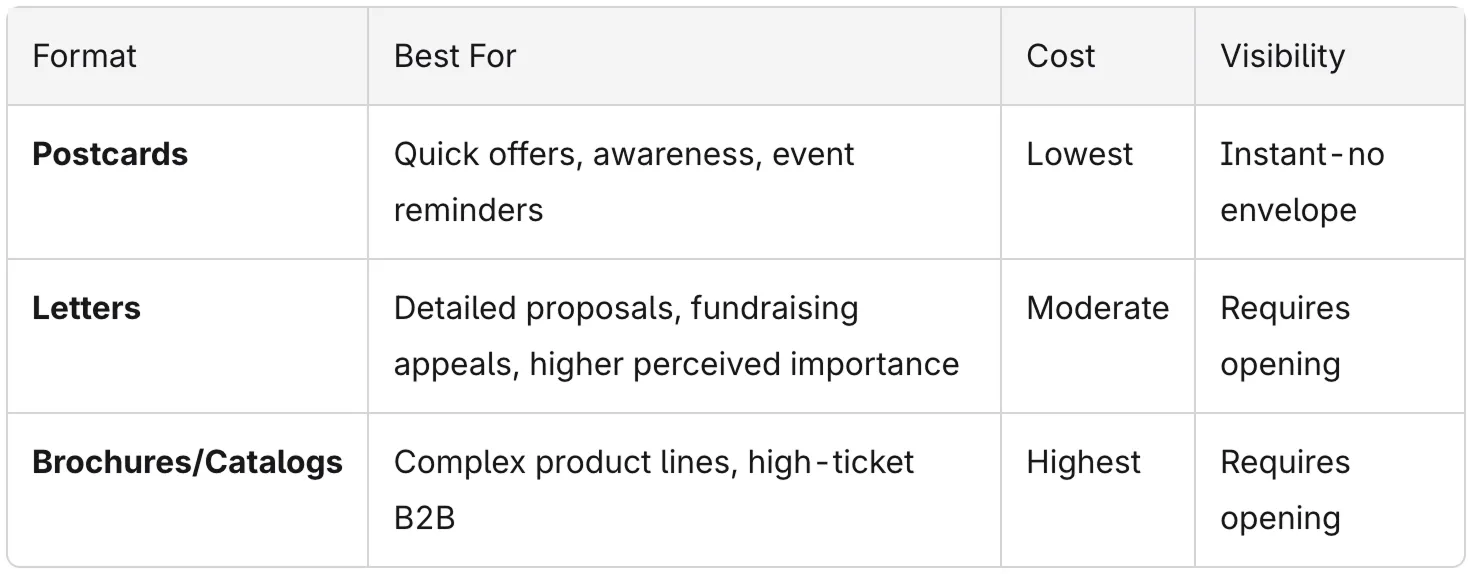
Format | Best For | Cost | Visibility |
|---|---|---|---|
Postcards | Quick offers, awareness, event reminders | Lowest | Instant - no envelop |
Letters | Detailed proposals, fundraising, appeals, higher perceived importance | Moderate | Requires opening |
Brochures/Catalogs | Complex product lines, high-ticket B2B | Highest | Requires opening |
Location independence doesn't mean losing your physical marketing presence. Consider this scenario: a consultant working from Lisbon in 2026 schedules client thank-you postcards to be mailed to US addresses via MailerBot, all from their laptop. No printer, no post office, no country limitations on creativity.
Remote-first companies also use postcards for employee engagement: welcome cards for new hires, holiday greetings, or milestone celebration cards mailed to home addresses across the country. It's a tangible way to engage a distributed society of teammates.
Keep in mind that international postage costs and delivery times vary. Plan campaigns at least two to three weeks ahead when mailing across borders, and consider using locally relevant imagery for greater amount of impact.
Personalized mail pieces see response lifts of up to 135% compared to static generics.
Avoid these pitfalls that weaken campaigns and waste money:
- No clear CTA or too many CTAs: If recipients don't know what to do, they won't do anything. Pick one action.
- Tiny fonts or cluttered layouts: If it can't be read at arm's length, it won't be read at all.
- Generic, non-personalized copy: Feels like junk mail. Use merge fields to buy attention and relevance.
- Poorly targeted lists: Sending to outdated or unfiltered addresses without adequate research wastes your budget.
- No tracking or testing: Without measurement, you can't justify the investment or improve future campaigns.
- Inconsistent branding: If your postcard looks nothing like your website or emails, consumers will distrust the QR code or URL. Maintain a consistent brand identity across every touchpoint.
Building a Repeatable Postcard System with MailerBot
The real power of postcards comes from making them a habit, not a one-off. Here's a repeatable loop:
- Define goal (acquisition, retention, reactivation, fundraising)
- Research and segment your audience
- Design and personalize using templates and merge fields
- Send via MailerBot (manual, Zapier, Make.com, or API)
- Track and analyze results against benchmarks
- Refine and repeat
Marketing teams can templatize postcard designs and workflows so future campaigns take hours, not weeks. Integrate MailerBot flows into your standard marketing playbooks alongside email and ad campaigns for launches, promotions, and retention plays. Document your triggers, segments, and template variants in an internal "direct mail playbook" so consistency holds as teams grow.
The American Marketing Association emphasizes that marketing refers to activities and processes for creating, communicating, and delivering value. Postcards, when systematized, become one of the most reliable distribution channels for that value-especially when your competitors haven't figured this out yet.
Ready to Automate your direct mail?
Start sending in minutes. No monthly fees, no minimums.
Frequently Asked Questions about Postcards and MailerBot
MailerBot is designed for both small tests and large campaigns. You can start with even one postcard in our platform, but we recommend testing with a few dozen postcards as a pilot before scaling to thousands or tens of thousands. Many customers begin with a tightly targeted test batch, validate response rates, and then roll out broader campaigns using the same templates and automations.
Printing and processing typically complete within one business day. USPS delivery then takes 3–10 business days depending on mailing class and destination. Timeframes can stretch during holiday peaks (late November through December), so plan campaigns at least two weeks ahead of critical dates.
Not necessarily. While professional design helps, many teams use simple, well-structured templates with clear headlines, strong imagery, and a single CTA. Follow the design best practices covered above and reuse a few core templates rather than designing from scratch each time. Product improvement happens through testing, not through bigger design budgets.
High-performing categories include home services, healthcare, real estate, retail, eCommerce, nonprofits, education, and professional services. Any organization with a clear offer, a defined audience, and physical mailing addresses can benefit-including remote-first companies and solo creators in the industry.
Using Zapier or Make.com requires no coding. Marketers build automations through visual workflows connecting CRMs, e-commerce platforms, and MailerBot. API integrations may require a developer for initial setup, but once live, they run automatically-letting marketing teams trigger highly personalized postcards and letters without manual work. It's developing a system that runs in the future without constant oversight.

Print to Mail Service: How PDF-to-Mail Solutions Like MailerBot, DocuPost, and LetterStream Transform Business Mail
A print to mail service is an online mailing process where users upload documents, enter addresses, and the platform prints, inserts, and delivers physical mail via usps.
Home Services Postcards: 6 Proven Ways To Win More Local Customers
Home services postcards help local trades reach homeowners and stay booked. Here are six proven ways to generate leads, retain clients, and win more jobs.
Nonprofit Mailers: How Nonprofits Can Use Letters and Postcards to Drive Donations
Physical mail remains a powerful tool for nonprofits to raise funds and engage donors. Here are six ways to use mailers to increase donations, reduce postage costs, and automate campaigns with platforms like MailerBot.